
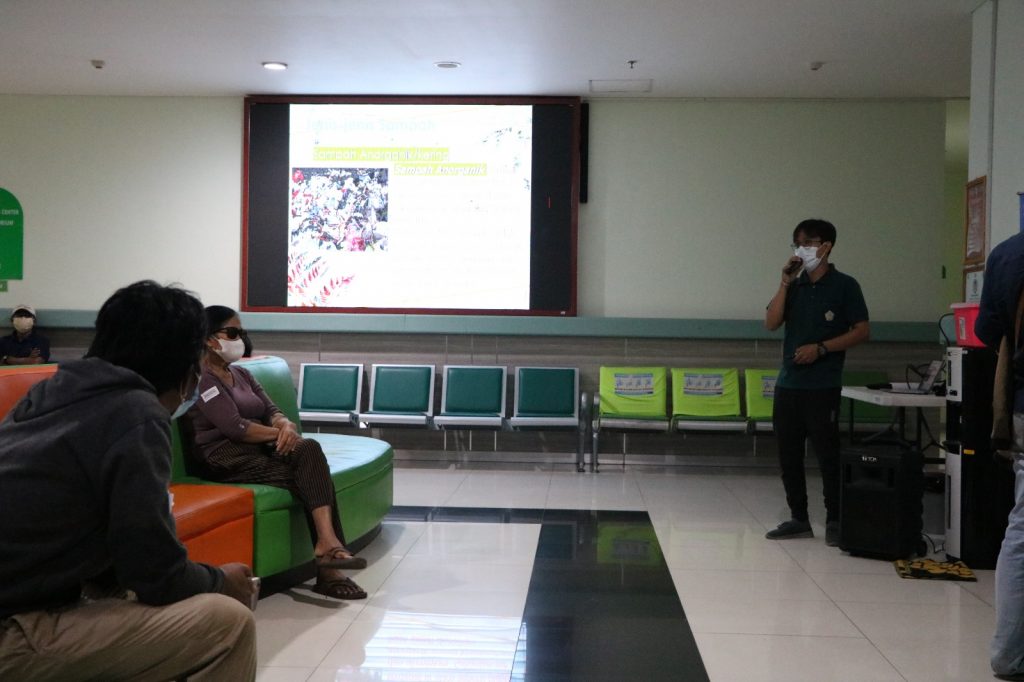
Friday, January 27, 2023, the PKRS unit held counseling on Waste Sorting and Processing in the Polyclinic waiting room with the resource person from the Sanitarian Team: I Ketut Semadi Widiantara, A.Md.K.L.
Waste is material that has no value or value for regular or special use in production or use, damaged / defective goods during manufacturing / excessive or discarded material. Waste is a material that is wasted or discarded from the source of human activity or natural processes that have no economic value. waste if not managed properly can be dangerous to the environment and health. The dangers of waste that can be caused include: causing pollution such as soil and water pollution, causing unpleasant odors, becoming a vector nest and disturbing beauty. Sources of waste sources can come from Hospital Household activities. Usually household waste is in the form of food processing waste, used household equipment, paper, cardboard, glass, cloth, garden / yard waste and others. There are three types of household waste in hospitals, namely, inorganic waste, organic waste and residual waste.
Inorganic waste is waste that is difficult to decompose but has economic value such as used beverage bottles. Inorganic waste in hospitals uses bins with red stickers and information. Organic Waste is waste that is easily decomposed and consists of plant and animal constituent materials that come from nature or are generated from agricultural, fisheries, household or other activities. Organic waste in hospitals generated such as waste from the yard/garden, ceremonial materials, vegetables and others. Organic waste bins in the hospital use green stickers and there is a description. Organic waste in the hospital is processed as compost for fertilizer needs in the hospital garden. Residual waste is part of household waste, where residual waste cannot be used (Reuse) or processed (Recycle) or composted. Usually it has no economic value. For example: Durian skin (Organic), electronic goods, plastics, rice paper, waste products from the printing process, residual waste is usually also in the form of B3 such as batteries and lamps. Residual waste bins in hospitals use ash-colored stickers and have a description. The residual waste is collected at the Hospital TPS and then disposed of at the Kreneng TPS.
Bali Mandara Eye Hospital also produces B3 waste from medical service activities. the most generated waste is infectious waste. Infectious waste is waste that is exposed to human body fluids. This waste is dangerous because there are viruses in it that can interfere with health. The infectious waste generated is disposed of in a trash can with a yellow sticker and a description. Examples of infectious waste in daily activities such as masks that are often used. Infectious waste should not be disposed of carelessly. How to dispose of used masks by :
- Remove the mask through the strap from the back of the head/ears
- Fold the mask so that the germs/droplets are on the inside of the fold.
- Mask disinfection with disinfectant/chlorine/bleach liquid
- Damage the mask by cutting off the strap and cap
- Dispose of immediately in a closed trash can
- Wash hands with soap and running water/use hand sanitizer